
MCP client
Receives your request, chooses a tool, supplies its typed arguments, and decides how results are presented to you or a model.
simplelogin-mcp is a bridge you run between an MCP client and the SimpleLogin API. It does not
replace SimpleLogin, host an account, or move alias routing into the MCP client.
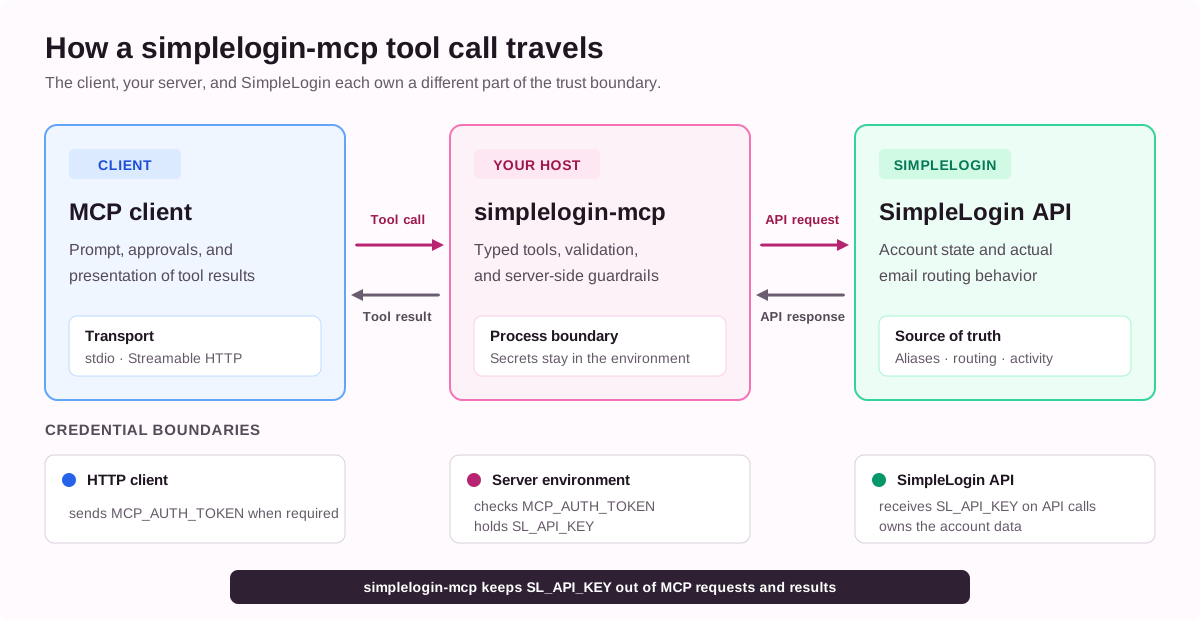
simplelogin-mcp never places SL_API_KEY in MCP requests or results. Do not put the key in prompts. HTTP clients send the separate MCP_AUTH_TOKEN when configured or required; stdio does not use it. Permanent deletion tools also require an explicit confirm=true argument.
The client connects. It launches the server over stdio or sends MCP requests to POST /mcp
over Streamable HTTP.
The server checks the boundary. HTTP requests are checked for an allowed browser origin and, when configured, a matching bearer token.
The tool validates its input. Schemas reject malformed arguments. Sensitive operations add
preconditions such as confirm: true, explicit mailbox transfer choices, or non-empty changes.
The server calls SimpleLogin. SL_API_KEY is sent to the configured SL_API_URL. Each
outbound request has a timeout, and mutations are not retried automatically.
The response is checked and bounded. Typed response schemas catch unexpected upstream shapes. List tools use documented pages or local bounds to avoid unbounded MCP results.
The client receives the result. The MCP client decides whether and how that result is sent to a model, displayed, retained, or used in a later tool call.
MCP client
Receives your request, chooses a tool, supplies its typed arguments, and decides how results are presented to you or a model.
simplelogin-mcp
Validates configuration and tool arguments, enforces local guardrails, calls the documented SimpleLogin endpoint, validates its response, and returns a bounded MCP result.
SimpleLogin
Owns the account, aliases, mailboxes, domains, contacts, settings, and actual email forwarding behavior.
| Shape | Process and network boundary | Best fit |
|---|---|---|
| Local stdio | The MCP client launches a child process. No HTTP listener opens. | One local desktop or command-line client. |
| Direct Node.js — Streamable HTTP | A persistent Node.js process listens on loopback by default. | Same-machine clients that support Streamable HTTP. |
| Docker Compose — Streamable HTTP | A container listens internally on 0.0.0.0:3000; Docker publishes it on host loopback by default. |
Operator-managed or self-hosted deployments. |
All three expose the same tool catalog. The choice changes how the client reaches the server and where its environment secrets live—not which SimpleLogin actions are available.
The Streamable HTTP endpoint creates a fresh MCP server and transport for each POST /mcp; it does
not keep an application session id or a project database. GET /health returns only process status
and version. SimpleLogin remains the source of truth for account state.
Continue with Security & Data for credentials, network exposure, and guardrails, or set up your MCP client to connect over stdio or Streamable HTTP.